


AI Governance Playbook - A Step-by-Step Guide for Enterprises
Are you looking for a practical way to manage AI risks, establish clear responsibilities, and use artificial intelligence more confidently across your enterprise? A structured approach can help you move from scattered AI policies to a governance process that supports responsible innovation.
AI governance is the framework of policies, roles, processes, and controls that guides how an organization develops, deploys, and manages AI systems. It helps enterprises address risks, maintain accountability, protect data, and monitor AI throughout its lifecycle.
In this blog, you will learn how to build an AI governance framework, assess AI risks, define responsibilities, implement security controls, and monitor AI systems after deployment.
What Is AI Governance?
AI governance is the system an organization uses to ensure that AI is developed and used responsibly. It connects business objectives with risk management, security, compliance, and human oversight.
For enterprises, enterprise AI governance helps decision-makers understand where AI is being used, who is accountable for its outcomes, and what safeguards are needed before a system goes live.
Effective governance is not just a policy document. It requires practical procedures, technical controls, clear ownership, and regular reviews as AI systems and business needs change.
Why Is AI Governance Important for Enterprises?
AI can improve decision-making, automate tasks, and support new services. However, poorly managed systems may expose sensitive information, produce unreliable results, create unfair outcomes, or make decisions without sufficient oversight.
A clear governance approach helps organizations identify these issues early and decide how each AI use case should be approved, monitored, and improved.
Key benefits include:
Better risk management: Identify potential problems before they affect business operations.
Clear accountability: Assign responsibility for AI decisions, approvals, and ongoing monitoring.
Stronger AI security: Protect data, models, applications, and connected systems.
Improved compliance readiness: Document controls and evaluate relevant legal and regulatory obligations.
Responsible innovation: Give teams a consistent process for evaluating and adopting AI.
AI Governance Playbook: 7 Steps for Enterprises
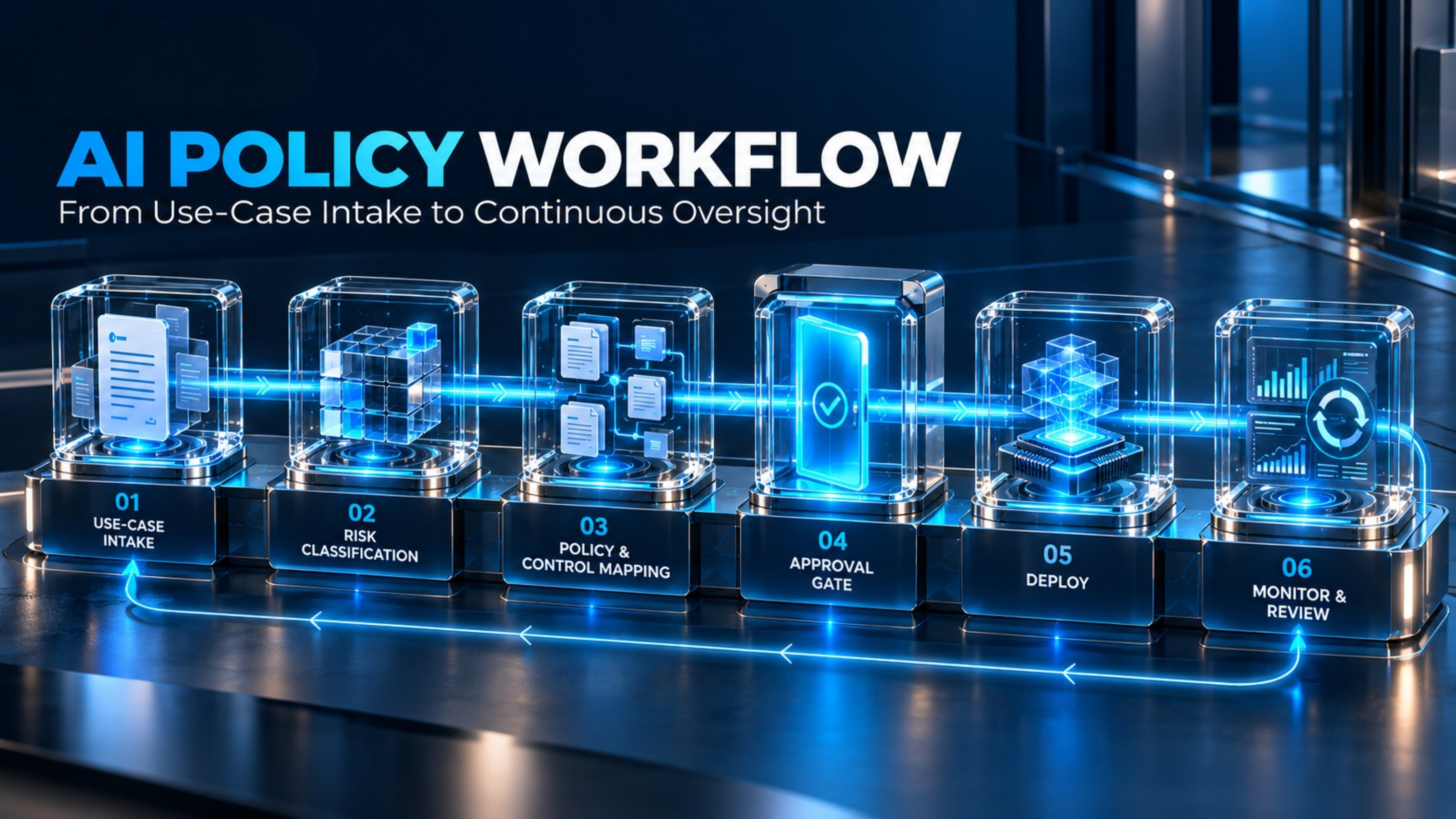
Here, we walk through seven practical steps enterprises can follow to build an effective AI governance strategy, manage AI-related risks, establish clear policies, and ensure responsible AI adoption across the organization.
Step 1: Identify AI Systems and Use Cases
Start by identifying where AI is already being used and where teams plan to introduce it. Include internally developed models, third-party AI platforms, generative AI applications, and AI agents connected to business tools.
Create an inventory that records each system's purpose, business owner, users, data sources, supplier, and deployment status. This gives leadership a clear view of the organization's AI environment.
The inventory should also identify systems that process sensitive information or influence important business decisions. These use cases may require additional review before approval.
Step 2: Evaluate AI Risks and Business Effects
The next step is to evaluate how each AI system could affect customers, employees, operations, information security, and business continuity.
An AI risk assessment should consider the likelihood and potential impact of different risks. These may include inaccurate outputs, privacy concerns, biased results, unauthorized access, unreliable third-party services, and misuse of AI-generated information.
Assign a risk level to each use case and document the reasoning behind it. Higher-risk systems may need deeper testing, specialist review, stronger human oversight, and formal approval before deployment.
Step 3: Build an AI Governance Framework
An effective AI governance foundation turns risk assessment into consistent rules that teams can follow. It should explain which AI activities are permitted, which require approval, and which are prohibited.
Your framework may cover acceptable AI use, data handling, model selection, supplier assessment, testing requirements, human oversight, incident reporting, and system retirement.
Policies should be specific enough to guide everyday decisions. For example, employees should know whether they can submit confidential business information to an external AI tool and which approval process applies to a new AI application.
Step 4: Define Roles and Responsibilities
AI governance works best when ownership is clear. Business leaders, technology teams, security specialists, legal advisers, risk professionals, and system owners may all have responsibilities at different stages.
Create a responsibility model that identifies who proposes an AI use case, evaluates its risks, approves deployment, monitors performance, and responds to incidents.
A governance committee can coordinate decisions across departments, while individual system owners remain accountable for their assigned systems. The structure should fit the organization's size, complexity, and risk exposure.
Step 5: Integrate AI Security and Testing
Governance policies need technical controls to work effectively. Security and testing should be integrated into the AI development and deployment lifecycle rather than treated as a final approval step.
Depending on the system, controls may include access restrictions, encryption, secure data pipelines, logging, model evaluation, and environment separation.
For generative AI applications, testing may also cover prompt injection, sensitive information disclosure, unsafe outputs, and misuse of connected tools.
For agentic AI, additional safeguards may be necessary because AI agents can interact with external systems or execute actions. Define their permissions, restrict access to critical functions, and require human approval for high-impact actions where appropriate.
AI security assessment and ongoing testing can help organizations identify weaknesses before and after deployment.
Step 6: Establish Compliance and Documentation Processes
Organizations should identify the laws, regulations, contractual obligations, and internal standards that apply to their AI activities. Requirements can vary according to the industry, data involved, intended use, and locations where the organization operates.
Document risk assessments, approvals, testing results, data sources, supplier reviews, and important governance decisions. Maintain evidence showing which controls are in place and who is responsible for them.
Where relevant, organizations can assess how their processes align with recognized standards, such as ISO/IEC 42001, the AI management system standard. Alignment should be evaluated against actual requirements rather than assumed from having a policy in place.
Step 7: Monitor, Review, and Improve AI Systems
AI governance continues after deployment. Model updates, changing data, new integrations, and evolving business needs can introduce risks that were not present during the original assessment.
Define monitoring measures that match each system's purpose. These may include output quality, security events, unexpected behavior, access activity, user feedback, and changes in business impact.
Set review schedules and establish a process for reporting incidents, investigating concerns, and updating controls. Reassess systems when their intended use changes significantly or new risks emerge.
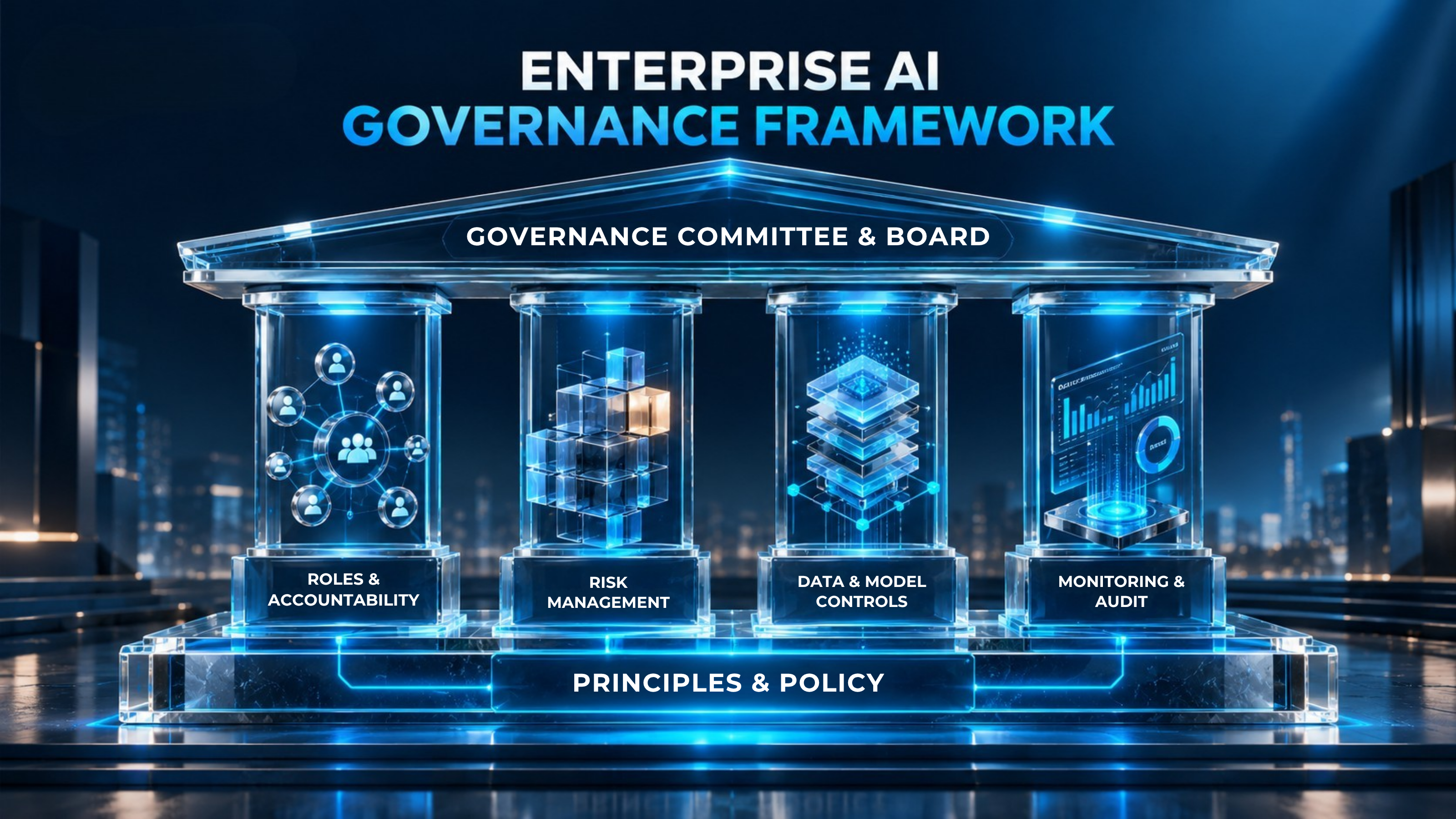
AI Governance Checklist for Enterprises
Use this table as a starting point to review whether your organization has the core elements of an AI governance process in place.
Governance area | What to check | Desired outcome |
AI inventory | Are AI systems and owners documented? | Clear visibility |
Risk assessment | Are risks and impacts evaluated? | Risk-based decisions |
Governance policies | Are acceptable uses and restrictions defined? | Consistent practices |
Accountability | Are roles and approvals assigned? | Clear ownership |
AI security | Are access, data, and testing controls applied? | Reduced exposure |
Compliance | Are applicable obligations reviewed? | Documented readiness |
Monitoring | Are performance and incidents reviewed? | Ongoing oversight |
Review this checklist regularly and adapt it to your organization's risk profile. A checklist supports implementation, but it does not replace a detailed assessment of individual AI systems.
Common AI Governance Challenges
Here, we explore the key challenges organizations face when implementing AI governance, from limited visibility and unclear ownership to gaps in technical controls and ongoing monitoring.
Lack of Visibility
Employees may adopt AI tools without formal review, leaving security and leadership teams unaware of how company information is being processed. An AI inventory and clear rules for tool approval can help reduce this gap.
Unclear Ownership
Governance can become ineffective when teams assume another department is responsible for AI risks. Assign named owners and define approval responsibilities for each stage of the AI lifecycle.
Policies Without Technical Controls
A written policy cannot prevent every security issue on its own. Organizations should connect governance requirements to access management, testing, monitoring, and incident response processes.
Limited Ongoing Monitoring
A system that performs well during testing may behave differently after updates or changes in its environment. Regular evaluation helps teams identify emerging issues and decide when intervention is needed.
How to Make AI Governance Part of Everyday Operations
AI governance should be integrated into existing business and technology processes instead of creating unnecessary approval layers. Use risk-based reviews so that low-impact applications follow a proportionate process while sensitive or high-impact systems receive deeper scrutiny.
Provide practical guidance and training so employees understand approved tools, data restrictions, reporting channels, and their responsibilities. Review the framework as AI adoption grows, and use findings from testing and incidents to improve controls.
For organizations managing complex AI environments, AI governance consulting can help assess current practices, identify gaps, and develop a structured implementation roadmap. The approach should reflect the organization's actual systems, risk exposure, and business objectives.
Building Trust Through Responsible AI Adoption
AI adoption is not just about performing advanced technology. It is about ensuring that every AI-driven process remains transparent, secure, and accountable. For enterprises, responsible AI adoption means focusing on three essential priorities:
Visibility: Understand where AI is being used and how it impacts business operations.
Accountability: Establish clear ownership of AI systems, decisions, and outcomes.
Governance: Apply consistent policies, risk controls, and human oversight throughout the AI lifecycle.
When these elements work together, organizations can reduce uncertainty, strengthen trust, and scale AI initiatives with greater confidence.
Ready to Make AI Adoption More Responsible?
Discover how LARETH.AI approaches responsible AI adoption and why visibility, accountability, and governance matter for modern enterprises.
Final Thoughts
A strong AI governance framework helps enterprises manage risk, strengthen accountability, and adopt AI with greater confidence. Start with clear ownership, practical controls, and continuous monitoring, then improve the approach as your AI environment evolves."Looking to strengthen your enterprise AI governance strategy? Contact Our team to discuss your requirements."
Frequently Asked Questions
1. What is an AI governance playbook?
An AI governance playbook is a practical guide that defines how an organization approves, manages, secures, and monitors AI systems. It translates governance principles into roles, procedures, controls, and review activities.
2. What are the main components of an AI governance framework?
The main components include AI inventory, risk assessment, governance policies, assigned responsibilities, security controls, compliance reviews, documentation, and ongoing monitoring.
3. How can enterprises implement AI governance?
Enterprises can begin by identifying their AI systems, assessing risks, establishing policies, assigning owners, integrating security testing, documenting relevant obligations, and monitoring systems after deployment.
4. Why is AI risk assessment important?
An AI risk assessment helps organizations understand possible harms, prioritize safeguards, and decide whether a system needs additional testing, human oversight, or approval before use.
5. How does AI governance improve security?
AI governance establishes rules for access, data handling, security testing, incident response, and monitoring. These estimations help companies to clarify and control risks across the AI lifecycle.
6. What is the difference between AI governance and AI compliance?
AI governance is the overall framework for controlling AI responsibly. AI compliance focuses on meeting applicable legal, regulatory, contractual, and other formal requirements.
7. Who is responsible for AI governance in an enterprise?
Responsibility is shared across leadership, business owners, technology, security, risk, and legal teams. Each AI system should have clearly assigned ownership and defined approval responsibilities.
8. How often should an AI governance framework be evaluated?
Organizations should establish regular reviews based on risk and system use. They should also reassess controls after significant model updates, changes in intended use, security incidents, or relevant regulatory developments.
9. What security risks should AI governance address?
Depending on the application, risks may include data exposure, unauthorized access, prompt injection, unreliable outputs, model vulnerabilities, misuse of connected tools, and unsafe actions by AI agents.
10. Can ISO/IEC 42001 support AI governance?
Yes. ISO/IEC 42001 provides requirements for an AI management system and can assist organizations structure their governance procedure. Organizations should assess the standard's needs and their own require before deciding how to apply it.


Leave a comment
Your email will not be published. All comments are reviewed before appearing.